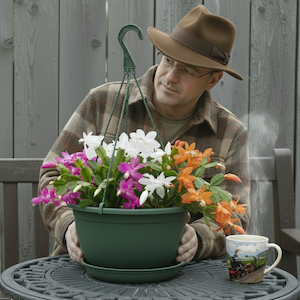
If you’re looking to create a living chandelier of vibrant blooms within your home, few houseplants do it better than the Schlumbergera family. Known affectionately in the UK as Christmas or Thanksgiving Cacti in the US, these forest-dwelling succulents are naturally epiphytic, meaning they grow nestled in tree branches rather than in the ground. Because of their arching, pendulous stems, they are the perfect candidates for a decorative indoor hanging basket, transforming a bright corner of your lounge or conservatory into a waterfall of seasonal colour.
Before you begin, consider how combining multiple varieties in a single basket can maximise both visual interest and seasonal impact. Mixing different varieties in a single basket creates a stunning “confetti” effect that brightens up the darker British winter months. Unlike the desert cacti, Schlumbergera thrive in the average warmth of a UK home, provided they have the right humidity and light. Here is how to design, plant, and maintain your mixed indoor display.
Choosing your varieties
The secret to a successful mixed basket is understanding the types commonly found in UK garden centres. While they look similar, they are often timed for different holidays. Thanksgiving Cacti S. truncata feature spiky leaf edges and usually bloom from late October through November. The True Christmas Cactus S. x buckleyi has smoother, rounded segments and tends to bloom from late December into January. Finally, the Easter Cactus Rhipsalidopsis provides a burst of star-shaped flowers in the spring.
If you want a massive explosion of colour all at once, your best bet is to mix different flower shades—such as vivid reds, soft pinks, and crisp whites—of the same species. However, if you prefer a “forever blooming” basket that provides interest across several months, you can mix different species so that as one finishes its display, the next is just beginning to bud.
The best setup: Pots and compost
Because these are indoor plants that require consistent moisture without being waterlogged, the choice of container and soil is vital. When growing them in a hanging basket indoors, it is often best to use a plastic hanging pot with an attached saucer to prevent drips on your carpet, or a decorative wicker basket with a waterproof liner. The compost must be incredibly well-draining to mimic the airy crevices of a tree canopy. A mixture of 60% peat-free multi-purpose compost and 40% perlite or fine orchid bark is ideal.
When planting, avoid the temptation to use a massive basket for small plants. Schlumbergera actually bloom more reliably when their roots are slightly snug. Aim to plant three to five starter plants around the edge of a 20cm to 25cm basket, angling them slightly outwards to encourage that iconic cascading habit. Place one upright plant in the centre to provide height while the outer plants begin to trail over the sides.
Caring for your indoor display
Maintaining a hanging basket indoors requires a slightly different approach than with a standard floor pot, as the air near the ceiling is often warmer and drier. Place your basket where it will receive bright, indirect light—an east-facing window is ideal, as it provides gentle morning sun without the intense midday heat of south-facing windows. To maintain proper humidity, mist the basket with water two to three times per week, or hang it in a humid, bright room such as a bathroom or kitchen. Check the soil moisture by feeling it every few days; water when the top inch feels dry.
Watering should be done whenever the top couple of centimetres of compost feel dry to the touch. From spring through to early autumn, you can feed your basket every fortnight with a balanced liquid indoor plant food or a half-strength tomato fertiliser to encourage strong growth. During the winter, reduce watering slightly, but never let the segments shrivel or the soil dry out completely.
The secret to numerous winter blooms
To trigger the famous floral display in time for the festive season, these plants require a rest period that begins in September. This is easily achieved by moving the basket to a cooler, unheated room—such as a spare bedroom or a porch—where the temperature stays around 15°C. They also require long nights, meaning they need about 12 to 14 hours of total darkness. Avoid keeping them in a room where artificial lights are turned on late into the evening during autumn, as this can trick the plant into thinking it is still summer, resulting in green growth but no flowers.
Once you see tiny, pin-head-sized buds forming at the very tips of the segments, you can bring the basket back into its flowing position. Be careful not to move it too abruptly or expose it to cold draughts at this stage, as Schlumbergera are notorious for dropping their buds if they get stressed. With a little care, these resilient houseplants can live for decades, becoming a cherished part of your indoor garden that grows more impressive with every passing year.