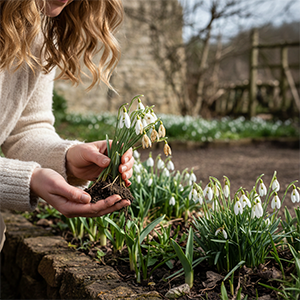
Moving snowdrops “in the green” is the most reliable method for establishing these winter gems in your own garden. Unlike most bulbs that are planted while dormant and dry in autumn, snowdrops have a high failure rate when left out of the soil for too long. Moving them “in the green” simply means lifting and replanting them while they are still in active growth—usually just after the flowers have faded but while the leaves are still lush and green.
The timing for this process typically falls between late February and early March. The primary advantage is that you can see exactly where the clumps are located, allowing you to space them naturally and avoid accidentally slicing through bulbs with a spade. Because the root system is active, the plants settle into their new place much faster than dry bulbs.
To begin, use a hand fork to gently lift a congested clump, digging deep enough to avoid damaging the bulbs. Once lifted, carefully tease the bulbs apart by hand. You should aim to plant them in small groups of three to five to create an immediate impact. It is vital to replant them immediately at the same depth they were previously growing; you can identify this by the point where the white stem turns green. Planting them too shallow is a common mistake that can cause the bulbs to dry out.
Select a spot that mimics their natural woodland habitat, favouring dappled shade and moist, well-drained soil rich in organic matter. Once placed in the ground, gently firm the soil and water well. The leaves will eventually yellow and die back naturally.
By continuing to browse this site, you agree to our use of cookies.