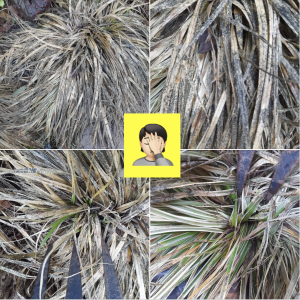
There are few things more humbling than buying a plant perfectly suited to the damp, gloomy corners of Britain, only to turn it into a crisp, greyish-yellow ruin by September.
Enter my Carex oshimensis ‘Evergold’.
It comes from the misty, permanently damp woodland floors of Japan and is perfectly happy in shade. So, naturally, I planted it in the shade.
Unfortunately, I had overlooked one tiny detail: dry shade. And dry shade, I’ve discovered, is basically a botanical desert.
During this summer’s relentless heatwave, the soil beneath it hardened like concrete. I watered it, but it was a losing battle. Within weeks, my attractive little sedge had become something resembling a packet of crisps I’d forgotten about in a hot car.
Thankfully, it isn’t quite dead. Beneath all that crispy misery there are still a few flashes of green. Apparently, this is actually part of the plant’s survival strategy: sacrifice the outer leaves to protect the crown at the centre.
Clever, isn’t it? Unlike me, who generally panics and reaches for the secateurs.
Then, because apparently the weather wasn’t finished with it, the heavens opened. A week of solid rain later, and that dead brown foliage wasn’t merely dry. It was furry with grey mould. Splendid.
The temptation now is to grab the shears and give the whole thing a brutal haircut right down to the soil. Don’t. Carex is an evergreen sedge rather than an ordinary grass, so cutting it hard back can damage the crown and leave it vulnerable to rot.
Instead, put on some gloves and get your fingers down into the base. Run them upwards through the foliage like a fairly aggressive comb. The dead leaves should pull away surprisingly easily.
For the stubborn, mouldy bits, use sharp, clean secateurs and snip them individually at the base, taking care not to remove the green growth beneath.
It’s fiddly, slightly tedious work, and you may spend several minutes wondering why you didn’t just buy a plastic plant.
But persevere. With a bit of luck, your Carex will recover. And, if nothing else, it might eventually forgive you for what you’ve done to it.